
Spotlight on Arts Audience Research Wave 6 & Symposium: Insights, Reflections, and What Comes Next

by Lisa Mackay
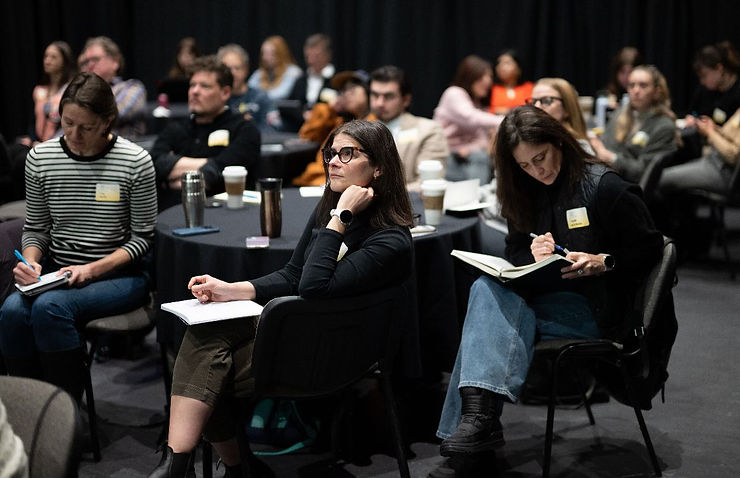
After two years and six waves of findings, the Spotlight on Arts Audiences research project concluded on November 24 with a day-long symposium at cSPACE Marda Loop. We chose to bring people together for a larger gathering to share the Wave 6 results because it felt like the right moment to do something more substantial than our earlier presentations. After tracking shifts in behaviour, attitudes, and expectations for two years, we saw a rare opportunity to step back and take stock of the arts landscape in Alberta at the end of 2025. What does it look like now? What challenges are emerging? What opportunities might be in front of us? And, most importantly, how do we adapt?
Mathew Stone and Kim Griffin from Stone-Olafson presented the final wave of research, along with practical guidance on how organizations can build or strengthen their own research and data strategies. Robin Sokoloski from Mass Culture followed with an overview of their work and a flexible data-collection framework that can be customized for any arts group or organization.
To help ground the findings in a broader context, we convened a panel of audience and marketing experts: Allison Wright, Director of Programming for the Stampede; Bradley King, Director of Engagement & Technology at the Edmonton Fringe; Sam MacMillan, Director of Marketing at Tourism Calgary; and Emily Schmidt, Director of Client and Team Member Experience at ATB. Their conversation with Mathew reinforced that audiences don’t separate their expectations by industry - whether they’re engaging with arts, retail, sports, or hospitality, customers' loyalty patterns, risk thresholds, and preferred experiences are remarkably consistent. The panel shared how their sectors are responding to these behaviours and what arts organizations can learn from these approaches. We then closed the day by highlighting the major themes that emerged across all waves of research and pointing to opportunities, mindset shifts, and loyalty-building practices worth exploring further.
This project would not have been possible without the commitment and generosity of our funding partners across the province. The Spotlight on Arts Audiences study is one of the largest and most comprehensive audience research initiatives ever undertaken in Alberta’s arts sector. Alberta Foundation for the Arts, Calgary Arts Development, Calgary Foundation, Edmonton Community Foundation, and Edmonton Arts Council all recognized the importance of long-term, province-wide research, and we’re grateful for their support in helping the sector move forward with clarity and confidence.

Six waves of research are no small undertaking, and Stone-Olafson approached each one with rigour, thoughtfulness, and a genuine curiosity about what Albertans are feeling and looking for from the arts. Their analysis helped us understand not only the data, but the stories within it—the motivations, anxieties, shifting habits, and emerging possibilities taking shape across the province.
We’re also grateful to the many artists, administrators, and community members who attended presentations and shared insights throughout the project. Your feedback shaped the direction of the research and ensured that the findings reflect real conditions and can be meaningfully applied to your work.
One of the clearest findings across the research is that today’s audiences do not look much like the audiences we knew in 2019. Even our most loyal attenders have shifted: their motivations are different, their decision-making is different, and the ways they want to engage—with us, with each other, and with their own time—have changed in subtle but significant ways. This means our systems, marketing practices, programming choices, and in some cases our business models, will need to evolve to stay relevant and responsive.
Despite the economic uncertainty, political fatigue, and general sense of heaviness that many Albertans described, one message came through consistently: the arts continue to offer light. People recognize the arts as places where they can gather, reflect, imagine, and feel something beyond the day-to-day pressures. As this project wraps up, that is what stands out most. The challenges facing the arts sector in 2026 are real, but so are the opportunities. Our work as artists, arts managers, and arts leaders matters now more than ever, and we have a meaningful chance to learn from each other, think creatively, and explore new ways to meet this moment.

The presentation slides from our symposium and the full Wave 6 report are now available at rozsafoundation.com/spotlightonartsaudiences. Reports focused on Calgary, Edmonton, and Rural Alberta will be added soon. We will also be organizing a second symposium event in Edmonton in January, so please keep an eye out for that notice
.Did you attend the event in Calgary? Have you used any of the research from this project? Are there elements you feel were missed or overlooked? We are happy to receive any feedback at lisa@rozsafoundation.com.
AUDIENCE DEVELOPMENT FUNDING FINAL INTAKE
The Rozsa Foundation’s Audience Development Funding Program is intended to allow organizations to build upon the findings and strategies emerging from the Spotlight on Arts Audiences research project. It enables arts organizations to engage arts audiences, learn more about their existing audiences and design and test new engagement strategies aimed at increasing attendance. This work can assist arts organizations to reposition their relationship to audiences, attracting new audience members in the short-term, while developing stronger connections with them in the long-term.
As the research project concludes, there is one final intake for this program Friday, January 23, 2026. Applications are due by 11:59pm on the deadline date.
For more information, visit rozsafoundation.com/audience-development.


Comments